BOSTON · FENWAY · ARRIVAL DECISION
Fenway Park Parking vs the T
For a Boston-based trip, compare the T before buying parking. Kenmore, Fenway station and Lansdowne are three different arrivals. Pick the one that fits your origin and your journey home, then plan the walk to the ballpark. The name on a station is not the whole decision.
Which option fits this game?
Green Line to Kenmore
The useful starting comparison for many city-based visitors. B, C and D serve Kenmore. Choose this if the connections and the return service work from your base.
Worcester Line to Lansdowne
A strong candidate when you’re already on that line. Your return is a timetable decision: check the stopping pattern and the departure you can realistically catch.
Drive, or park and ride
Compare this when your origin, group or onward trip makes transit awkward. Price the complete round trip and inspect the actual last leg before reserving.
First, understand the Boston network
The MBTA runs Boston’s subway and commuter-rail network. Use its map for the connection across the city; use the local diagram below for the final station-to-ballpark relationship. Neither replaces date-specific service or elevator alerts.
Selected core connections
Red Line
Change at Park Street for a westbound B, C or D to Kenmore.
Blue Line
Change at Government Center for a westbound B, C or D to Kenmore.
Orange Line
One option is Downtown Crossing, the Winter Street Concourse to Park Street, then a westbound B, C or D.
From North Station, the D branch gives a Green Line path to Kenmore. An E train does not serve Kenmore or Fenway; change onto B, C or D before the branches separate. Confirm the operating pattern for your date.
Plan from your actual starting point
Then, separate the three nearby stations
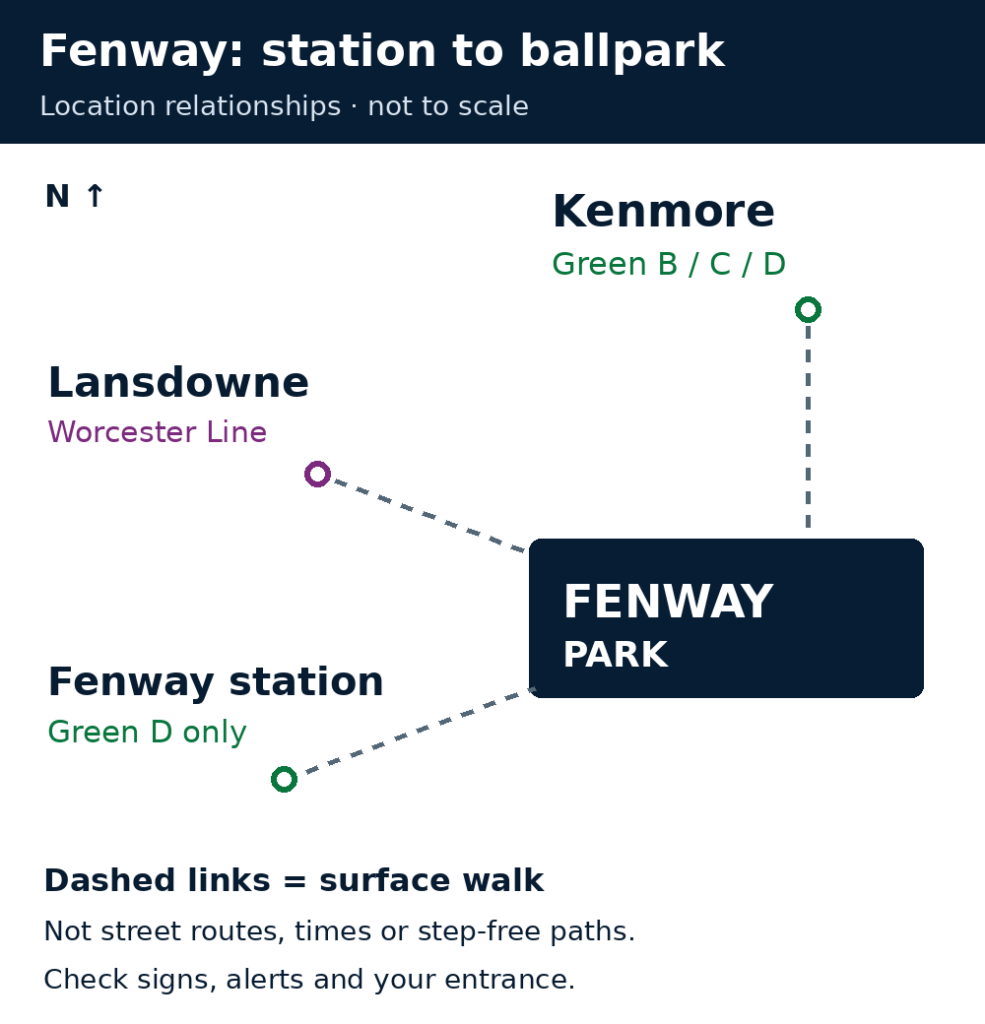
Read this as relationships, not directions
Kenmore is northeast of the ballpark; Lansdowne is northwest; Fenway station is southwest. All three require a surface walk. The diagram’s dashed links do not trace streets, station exits or accessible paths.
Kenmore: Green B/C/D. Fenway station: Green D. Lansdowne: Worcester commuter rail. The E branch serves neither Kenmore nor Fenway station.
For Kenmore’s ballpark approach, follow Fenway signs, then Commonwealth Avenue and Brookline Avenue across the bridge. Check the entrance on your ticket before committing to the final walk.
Read the Red Sox Kenmore walking directions
Lansdowne: a close station with a separate timetable
Commuter rail is its own service and fare system. Check trains in both directions, whether they stop where you need, and the last useful departure. An appealing arrival is not enough if the return sends you hunting for a different way home.
Decide what you’ll do if the game runs past your planned train: leave early, take a later verified departure or change the return mode. Do not build the trip around an assumed final-out time.
Read the date-specific Worcester Line timetable
If you drive, choose the approach before the space
The Red Sox parking guide groups garages by approach direction. Residential parking restrictions apply around Fenway.
Review garage approaches and parking rules
Compare each candidate on four things: the drive in, the walk to your entrance, the reservation’s arrival and exit terms, and the route home. A cheap space is less useful if its allowed hours do not cover your plans. Check the exact event, date, vehicle limits and total before paying.
Park-and-ride can split the journey: drive to a station, then use transit. Check the station’s parking, the train connection, the return service and how you’ll get from the platform back to your car. Parking inventory and service are separate questions.
Before you leave
Confirm the game or show time, both directions of travel and your last useful connection. Check current service and elevator alerts. If accessibility matters, verify the whole route with the operator and the ballpark rather than inferring it from proximity.
Leave room for the part you came for
Choose an arrival that lets you spend time around Fenway without keeping one eye on a parking meter or a fragile connection. Know your return, then let baseball take over. The transport plan has done its job when it stops being the main event.
Official sources checked October 5, 2026. Recheck event instructions and live transit alerts for your date. This is an orientation guide, not a live route planner. No fixed fares, parking prices, walk times or last-train times are assumed.